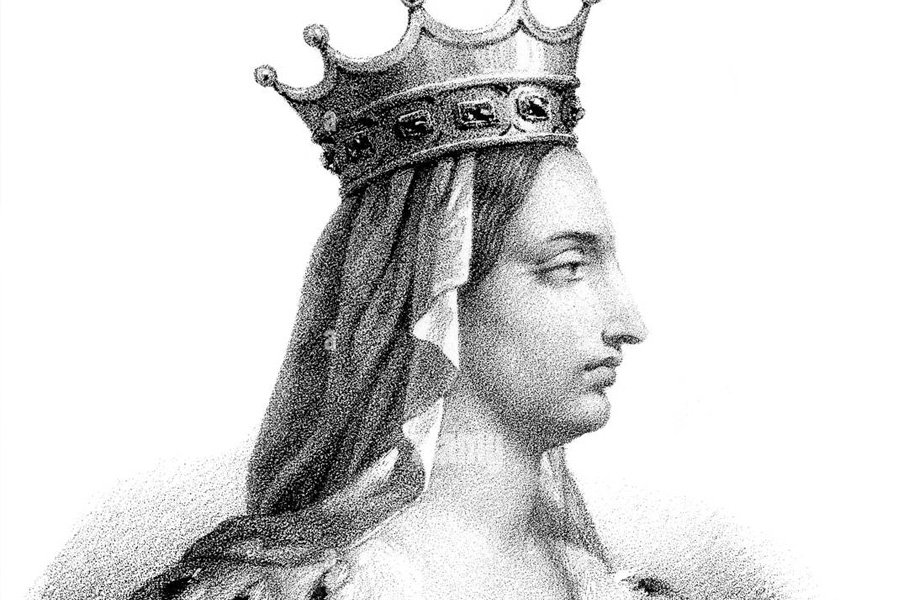
A compact portrait of Bertrada Of Laon
I write about Bertrada Of Laon because her life sits at a hinge of European history. Born sometime between about 710 and 727, she rose from the regional nobility of Laon to become queen consort of the Franks. She married Pepin the Short around 740 to 741. Pepin became king in 751. Bertrada then lived through the birth of a dynasty and the making of an empire. She died on 12 July 783 at Choisy au Bac and was buried at Saint Denis. Those are the hard dates that frame a life. The rest is human texture: alliances, children, church patronage, retirement, loss, and influence.
Early life and marriage
I picture Laon as a patchwork of estates and small courts. Bertrada was the daughter of Charibert of Laon. That connection mattered more than one might think. In the eighth century bloodlines were a kind of currency. Her marriage to Pepin the Short was both personal and political. The union was arranged in the early 740s. It was later regularized by the church because the partners were too close in kinship for contemporary canon law. That problem was solved. The marriage endured and produced the generation that reshaped Western Europe.
Children and family table
I like lists because they make dense family trees readable. The table below gathers the principal family members associated with Bertrada Of Laon and the key dates we can most confidently assign.
| Name | Relationship to Bertrada Of Laon | Dates and notes |
|---|---|---|
| Pepin the Short | Spouse | King of the Franks 751 to 768. Married to Bertrada circa 740 to 741. Died 24 September 768. |
| Charlemagne (Charles) | Son | Born circa 742. King and later Emperor. Principal heir and political actor of the family. |
| Carloman | Son | Born circa 751. Co ruler after 768. Died 771. |
| Gisela (Gisèle) | Daughter | Entered religious life (often associated with Chelles Abbey). Exact birth date uncertain. |
| Pepin (younger son) | Son | Born circa 756. Died young in 762 (dates and survival vary among sources). |
| Other daughters (Berthe, Adelaide, etc) | Daughters | Names and fates vary in records; several daughters are attested in different lists. |
| Charibert of Laon | Father | Regional count of Laon. Name anchors Bertrada to local power. |
| Grandchildren (examples) | Grandchildren | Pepin of Italy, Pepin the Hunchback (through Charlemagne), Louis the Pious, Charles the Younger and others born in 770s and 780s. |
I admit this table simplifies disputes and variant names. But it helps me tell the story.
Political role and influence
I think of Bertrada as a political fulcrum more than a campaigner. She helped make Pepin legitimate. She bore the sons who would occupy thrones. After Pepin died in 768 and Carloman died in 771, Charlemagne became sole ruler. Bertrada retreated from daily court business but remained a queen mother with status. Charlemagne provided her with residence and ensured her burial in the royal necropolis at Saint Denis. Her role was not always public, but in the courtly and ecclesiastical networks of the time that mattered deeply.
Land, donations, and the financial footprint
In the contemporary sense, we don’t have ledger books. Rather, we read property transfers, grants, charters, and gifts from monasteries. Records connected to religious foundations like Prum and associated establishments mention Bertrada and her family. These entries demonstrate the transfer of land and the use of patrimonial authority. To put it succinctly, the Carolingian household oversaw dozens of estates that supported clerical patrons, rode retinues, and generated food by the middle of the eighth century. The name Bertrada appears on that web. As a result, her financial influence is tangible but indirect through land and religious patronage.
Personal life, retirement, and last years
I imagine quieter years after 771. With Charlemagne dominant, Bertrada moved to Choisy au Bac for the last stage of her life. She died on 12 July 783 at an age probably between mid 50s and early 70s depending on the birth estimate. She was buried at Saint Denis. The stone and ceremony were statements. They announced continuity, legitimacy, and reverence for a queen who had produced kings.
The extended family as a living network
I never consider the family to be just a list of names. It was a dynamic power structure. Pepin the Short was more than just a husband; he was the catalyst for the monarchy that came from lineage. Charlemagne was the great result, not just a son. The sibling whose early demise cemented authority under Charlemagne was Carloman. In order to establish the dynasty in the church, the daughters entered the convent life. Claims and titles were passed down throughout Europe by grandchildren like Louis the Pious and Pepin of Italy. Marriage tactics, religious affiliations, and patrimonial transfers kept the family moving like an engine with interlocking gears.
How I read uncertainty and contradiction
I will be candid: early medieval genealogy is a patchwork. Names vary. Dates are approximate. Scholars disagree about some ancestors, and some daughters appear in some lists but not others. I treat the solid facts as dates and events that recur across the record: marriage to Pepin around 740 to 741, Pepin king from 751 to 768, the birth of Charlemagne around 742, Pepin’s death on 24 September 768, Bertrada’s death on 12 July 783. Around those anchor points the branches fan out and sometimes blur.
FAQ
Who were the parents of Bertrada Of Laon?
Her father was Charibert of Laon. The maternal line is less certain in surviving records. Genealogical reconstructions link her to regional aristocracy around Laon and to families that later supported monastic foundations.
How many children did she have?
The main children commonly attributed to her include Charlemagne, Carloman, Gisela, and at least one younger Pepin. Some lists record additional daughters with variant names. Countable and named children in many accounts number between four and eight depending on which sources one accepts.
What was her role as queen?
She was queen consort from 751 until Pepin’s death in 768. Her role blended ceremonial presence, dynastic motherhood, and household management. She also participated indirectly in the network of ecclesiastical patronage that underpinned Carolingian legitimacy.
Where and when did she die?
She died on 12 July 783 at Choisy au Bac and was buried at Saint Denis. Those dates are the conventional markers most often cited in medieval chronologies.
Did Bertrada Of Laon influence Charlemagne?
Yes. As mother she participated in the formation of a household and lineage that produced Charlemagne. Her status and connections helped shape the alliances and legitimacy that supported his rule. She influenced the human scaffolding around him even if she did not command armies herself.
Are there monuments or memorials to her today?
Yes. Various cultural memories and statues in later centuries have commemorated queens of France and notable medieval women. Her burial at Saint Denis remains the most enduring physical statement of her royal status.